
Voles
Voles belong to the Arvicolinae subfamily, which is part of the species-rich family Cricetidae, and they are closely related to lemmings and hamsters.Palaeontologists generally determine species based on the best-preserved element, most commonly the molars. In order to identify the taxon, it is necessary to first consider some general characters that allow an initial discrimination. After that, it is possible to focus on species-specific characters.
First of all, the presence or absence of roots in molars (rhizodont vs arhizodont) is a character that helps taxonomic identification. It is also a character that shows the evolutionary trends of voles during the Quaternary. During this period, vole teeth tend to become more hypsodont (high-crowned), and several taxa lose rooted teeth.
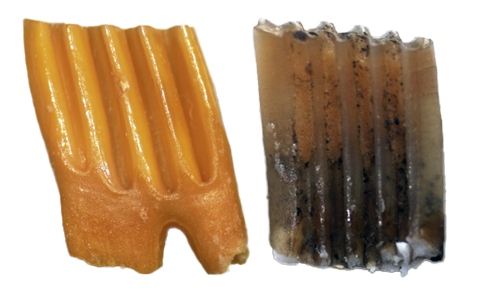
If we look at the occlusal surface (masticatory area), we can notice that vole teeth have a particular shape, adapted for chewing grasses and other hard plant material. Vole teeth are prismatic molars, characterized by a series of alternating triangles (prisms) formed by enamel folds.
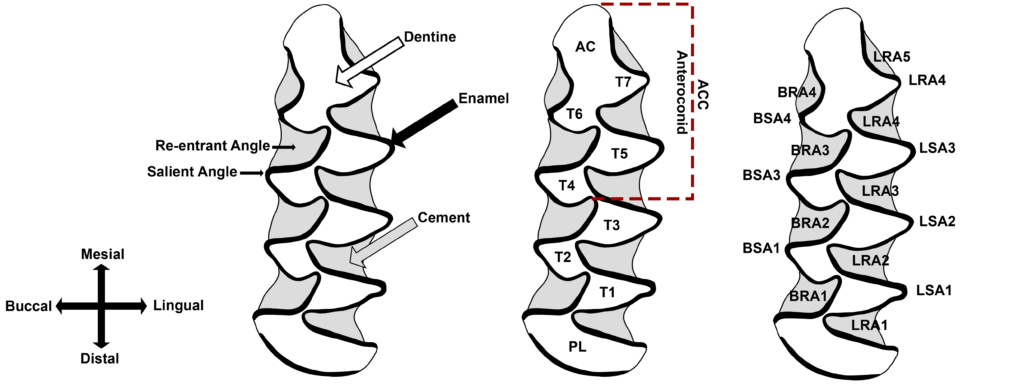
The presence or absence of cement along the valleys of the molar can help in taxonomical recognition. In some taxa, cement is well developed and clearly visible, while in others it is absent or very reduced. This feature, together with tooth morphology and enamel thickness, contributes to species identification.
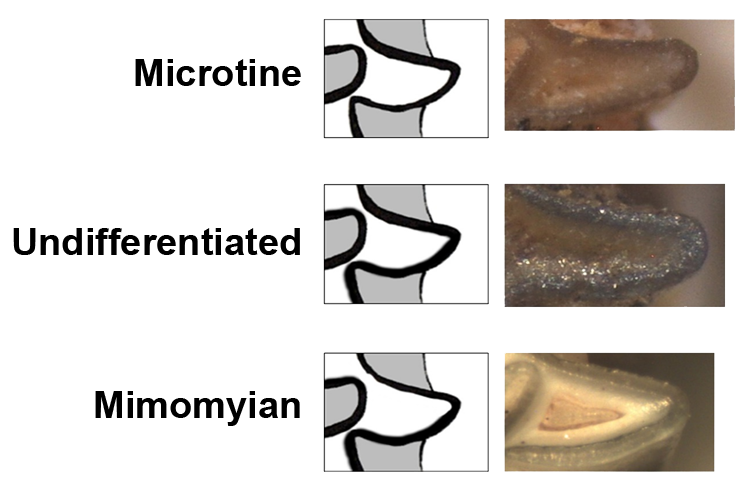
Another important diagnostic feature is the type of enamel thickness, which can be microtine, undifferentiated, or mimomyian.
When analyzing an individual triangle of the molar:
- Microtine enamel is thicker on the mesial side and thinner on the distal side.
- Mimomyian enamel shows the opposite pattern, being thicker on the distal side and thinner on the mesial side.
- Undifferentiated enamel displays a uniform thickness on both mesial and distal sides.
Enamel differentiation is a key character for distinguishing vole lineages and plays an important role in taxonomic identification.
For distinguishing the various taxa, palaeontologists concentrate on the larger and usually best-preserved element, the first lower molar (m1), even though some genera and species can also be identified from the other molars.
The identification process typically follows the scheme proposed by van der Meulen (1972), later refined by other researchers. This approach divides the m1 into three main components: the posterior loop (PL), a series of triangles (T), and the anterior cap (AC). Tooth elements can be described by analyzing the shape of the salient and re-entrant angles, both buccal and lingual (BSA/LSA: buccal/lingual salient angles; BRA/LRA: buccal/lingual re-entrant angles).
How to identify:
Chionomys nivalis – European snow vole
Alexandromys oeconomus – Tundra vole
Stenocranius anglicus – European narrow-headed vole